Annual Ann Riley Pink Tea for Cancer Awareness
Breast cancer survivor and advocate Meg Kinnard to emcee annual Ann Riley Pink tea event to bring awareness to need for better access and prevention policy in South Carolina.

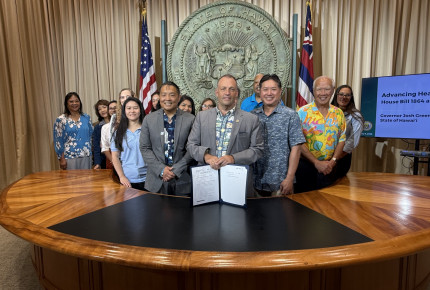
Gov. Josh Green took a major step toward treating and preventing colorectal cancer in Hawai’i by signing HB 1969 into law which establishes a state-funded financial assistance program to offer screenings for uninsured and underinsured individuals and treatment for uninsured individuals.
Follow up colonoscopies required after a non-invasive screening will also be covered under the new law. The bill signing took place during a ceremony at the state capitol on Thursday morning.
The American Cancer Society Cancer Action Network (ACS CAN) applauds the governor and state lawmakers for prioritizing the prevention and treatment of colorectal cancer. The disease is one of the most preventable and treatable cancers when detected early, yet it remains the second-leading cause of cancer death in Hawai’i.
“Today is a victory for public health in our state,” said Cynthia Au, ACS CAN Hawai’i Government Relations Director. “Hawai’i is taking the lead on fighting colorectal cancer as the disease continues to take the lives of our residents. Lack of insurance shouldn’t prevent people from getting screened or receiving follow-up treatment. We are confident the work of the legislature and governor in passing this legislation into law will have a significant impact for generations to come.”
Cost and lack of insurance are major barriers to getting recommended screenings which this law aims to address. People with health insurance coverage are more than twice as likely to be up to date with colorectal cancer screening, however for those without insurance, cost remains a significant obstacle.
Studies show early-stage detection leads to five-year survival rates of more than 90% in the United States.
According to the American Cancer Society (ACS), an estimated 840 Hawai’i residents will be diagnosed and 260 will die from the disease this year alone. Cases among people younger than 50 are rising, as well, with incidence increasing nearly 3.5% annually from 2013 to 2022, according to the Hawai’i Tumor Registry.
More than 20 million Americans who are eligible for colorectal cancer screening have not been undergone guideline recommended screening.
HB 1969 is effective immediately.