Overview
The American Cancer Society Cancer Action Network (ACS CAN) empowers advocates across the country to make their voices heard and influence evidence-based public policy change, as well as legislative and regulatory solutions that will reduce the cancer burden. As part of this effort, ACS CAN deploys surveys to better understand cancer patient and survivor experiences and perspectives, through our Survivor Views research panel. The panel is a group of cancer patients and survivors who respond to regular surveys and provide important insights to support ACS CAN’s advocacy work at all levels of government.
Fielded July 9-25, 2026, our latest survey explores the experiences and barriers cancer patients face related to participation in clinical trials and the impact of financial support to offset the costs of participation. The web-based survey was conducted among 1,015 cancer patients and survivors nationwide who have been diagnosed with or treated for cancer in the last seven years. More methodological detail follows at the end of this report.
Key Findings
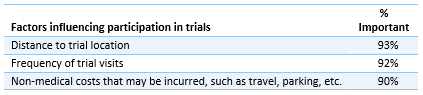
- Ninety-three percent of cancer patients and survivors say distance to a trial location is an important factor when considering participating in a clinical trial, and 69% say this is very important.
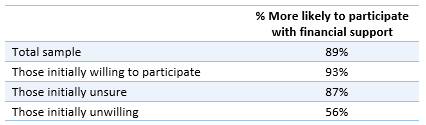
- Eighty-nine percent say they would be more likely to participate in a clinical trial outside their local area if trial sponsors helped them organize or pay for travel and lodging, with 58% much more likely.
- A majority (63%) of cancer clinical trial participants did not receive financial support from trial sponsors for transportation, lodging, food or other participation-related costs.
- The vast majority (83%) feel it would be ethical for participants in clinical trials to receive financial support from trial sponsors to offset travel, lodging, and food costs incurred as part of participating in a trial, and only 1% are concerned this is unethical. Meanwhile, 75% say it is unethical for patients participating in clinical trials to have to pay more out of pocket to be in a trial than they would for normal care.
Detailed Survey Findings
Financial Support to Offset Costs Boosts Willingness to Participate in Clinical Trials, but Majority Do Not Receive It
Over two-thirds of cancer patients and survivors (67%) say they would be willing to participate in a cancer clinical trial if their provider recommended it, while 28% are unsure and only 5% say they would not be willing to participate. Distance to trial location (93%), frequency of trial visits (92%), and non-medical costs such as travel (90%) are all important factors when considering participation in a trial.
In fact, 89% say they would be more willing to participate in a trial outside of their local area if the trial sponsor helped them organize or pay for travel and lodging to offset the extra travel. Among those who initially said they were unsure about their willingness to participate in a trial, 87% said they would be more willing to participate if the trial sponsor offered financial support for costs of participation, and even among those who initially said they would not be willing, more than half said they would be more likely to participate if financial support for participation costs was offered.
Among survey respondents who have participated in a clinical trial however, fewer than one-third (31%) received any form of financial support from the clinical trial sponsor (such as reimbursement or stipends to help offset costs for transportation, lodging, food, and medical expenses).
Cancer Symptoms and Treatment Side Effects Can Be Very Disruptive to Patients’ Lives
Opponents of providing financial support often cite ethical concerns about the practice; however, the vast majority (83%) feel it would be ethical for participants in clinical trials to receive financial support from trial sponsors to offset travel, lodging, and food costs incurred as part of participating in a trial, and only 1% are concerned this is unethical. Meanwhile, 75% say it is unethical for patients participating in clinical trials to pay more out of pocket to be in a trial than they would for normal care.
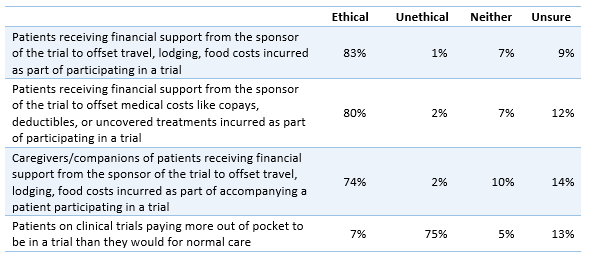
Patients also largely agree (80%) that it is ethical for participants to receive support from trial sponsors to offset medical costs like copays, deductibles, and treatment costs incurred as part of participating in the trial, and only 2% are concerned this is unethical. Nearly three-quarters (74%) also feel it is ethical for caregivers/companions of patients to also receive support to cover costs incurred as a result of accompanying a patient participating in a clinical trial, and only 2% are concerned this is unethical. Patients and survivors are less certain about the ethics of incentive payments from trial sponsors offered to acknowledge the time and effort involved to participate in a trial, with 55% considering this ethical, 11% unethical, and those remining feeling unsure (21%) or that it is neither ethical nor unethical (14%).
Patients and Survivors Strongly Prefer Prepayment
Patients were asked which of three forms of financial support they would prefer to help cover the costs of participation in clinical trials:
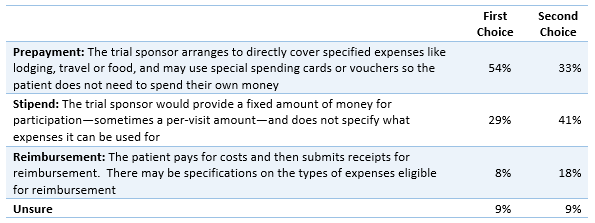
Cancer patients and survivors regularly report juggling a number of tasks essential to their survival and appreciate having some things managed by their providers. Over half (54%) say prepayment is their first choice when it comes to trials sponsors offsetting the costs of participation in clinical trials, followed by 29% who prefer a stipend. Only 8% select reimbursement as their first choice. Stipend is most often selected as the second choice (41%), followed by prepayment (33%).
Methodology
ACS CAN’s Survivor Views research initiative was designed to support the organization’s efforts to end suffering and death from cancer through public policy advocacy. Data provided by cancer patients and survivors as part of this project allows for a greater understanding of their experiences and opinions on cancer-related issues and gives voice to cancer patients and survivors in the shaping and advocating of public policies that help prevent, detect, treat, and survive cancer and promote a more positive quality of life for those impacted.
To ensure the protection of all participants in this initiative, all research protocols, questionnaires, and communications are reviewed by the Morehouse School of Medicine Institutional Review Board.
The survey population is comprised of individuals who meet the following criteria:
- Diagnosed with and/or treated for cancer within the last seven years
- Over the age of 18 (parents of childhood cancer survivors were invited to participate on behalf of their minor children)
- Reside in the US or US territories
Survivor Views participants are invited to participate through email, direct mail, social media, and outreach to communities and partners engaged with cancer patients and survivors. Those who agree to participate after reviewing the informed consent information are invited to join the Survivor Views research cohort and participate in future surveys. This survey also includes cancer patients and survivors nationwide from probability and non-probability panels. The data for this survey were collected between July 9-26, 2026. A total of 1,015 participants responded to the survey.
About ACS CAN
The American Cancer Society Cancer Action Network (ACS CAN) advocates for evidence-based public policies to reduce the cancer burden for everyone. We engage our volunteers across the country to make their voices heard by policymakers at every level of government. We believe everyone should have a fair and just opportunity to prevent, detect, treat, and survive cancer. Since 2001, as the American Cancer Society’s nonprofit, nonpartisan advocacy affiliate, ACS CAN has successfully advocated for billions of dollars in cancer research funding, expanded access to quality affordable health care, and advanced proven tobacco control measures. We stand with our volunteers, working to make cancer a top priority for policymakers in cities, states and our nation’s capital. Join the fight by visiting www.fightcancer.org.

